
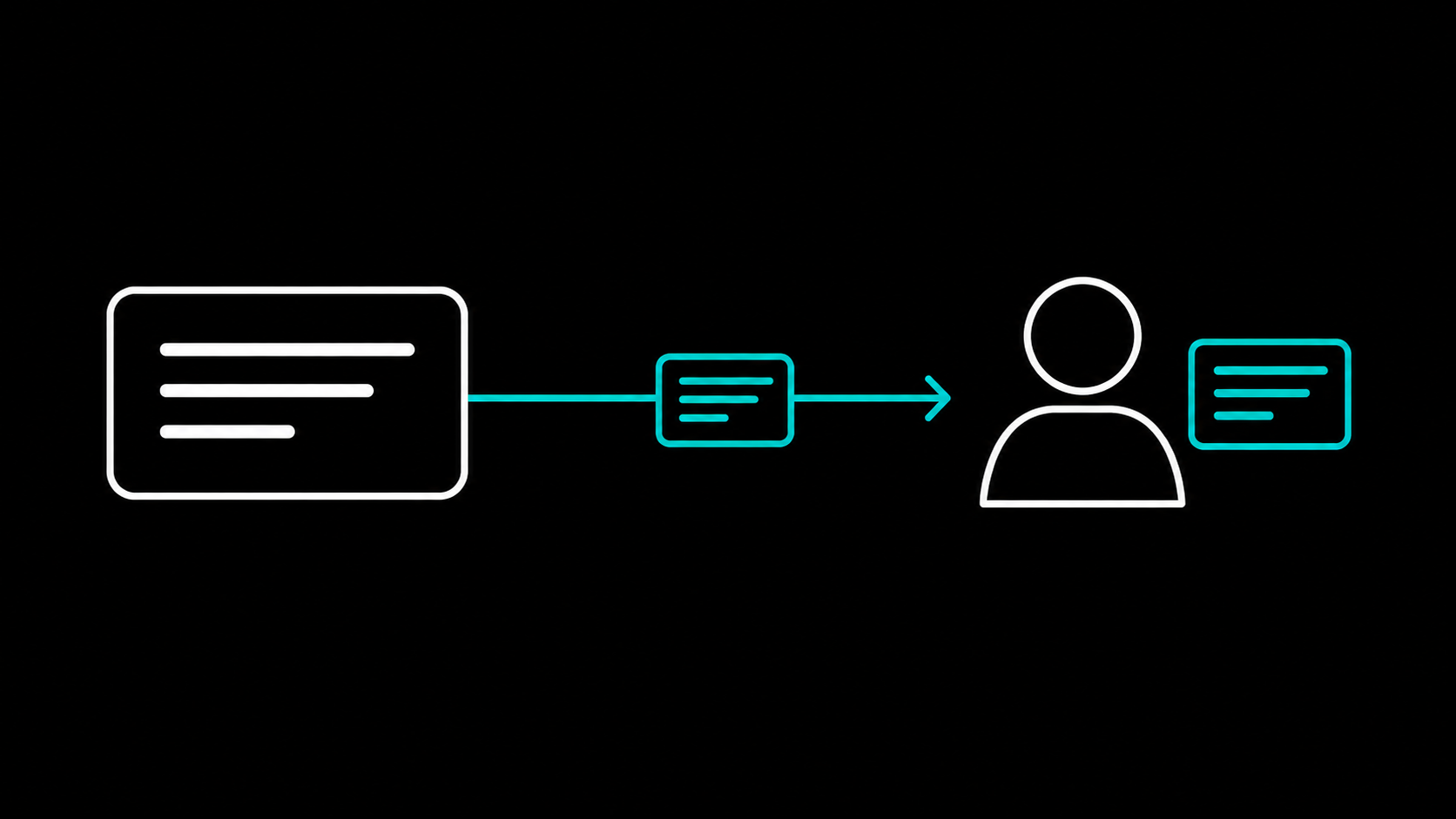
A customer explains a delivery problem to an AI assistant, answers several questions and asks for help from a person. The support agent joins with: “How can I help you?”
The technology has transferred the conversation. The service has lost its context.
This is an illustrative scenario, not a report about a particular company. It reveals a useful leadership question: when AI hands work to a person, does the customer move forward, or start again?
I would judge that transition by continuity, not just the speed of the automated reply. My VORTA material treats stakeholder expectations, user-journey impact and ownership as parts of adoption. Applied to customer service, that means designing what survives the handoff before judging the assistant in isolation.
Carry the customer's purpose, not just the transcript
A transcript records what was said. It does not necessarily make the next action clear. A support agent should not have to reconstruct a long conversation while the customer waits.
Create a short handoff brief with five clearly separated parts: the customer's requested outcome; relevant facts they supplied; steps already tried and their results; commitments already made; and the question still open. Keep links to the relevant original messages available to authorized staff when needed.
Distinguish a customer statement from a verified system record. “Customer says the package has not arrived” is different from “Delivery failed.” Likewise, an AI suggestion is not an action taken, and a requested refund is not an approved refund. The brief must preserve these differences rather than turn uncertain information into an apparently settled case.
This is where summarization quality becomes operational. The goal is not a smoother story. It is enough accurate context for the next person to help without forcing unnecessary repetition.
Let the customer correct the handoff
Before a transfer, show the customer a concise, plain-language summary where the channel supports it: “You want the missing item delivered, not a refund. You have already checked with reception. Is that right?” Offer a straightforward way to correct it without repeating the whole exchange.
Do not make this confirmation an extra obstacle when someone needs urgent assistance or cannot use the interface. If confirmation is unavailable, label the brief as unconfirmed. Staff can check the essential point rather than assume the customer accepted a generated interpretation.
For an illustrative missing-item case, a useful handoff could read: “Requested outcome: receive the missing item. Customer reports: one item was absent from the parcel. Already tried: checked the packaging. Still open: verify the order contents and available replacement options. No replacement or refund has been approved.”
That brief does not decide the remedy. It preserves the request and prevents the next person from offering the wrong solution based on an invented resolution.
Preserve context without spreading unnecessary data
Continuity does not mean copying every message into every system. Decide what the receiving team needs, what should remain in the original record and who is allowed to open it. Use existing approved retention and access rules rather than treating the handoff as permission to collect more information.
For example, a general support summary should not repeat payment credentials or unrelated personal details just because they appeared in the conversation. Nor should it replace a required identity check with “the chatbot already spoke to this person.” Explain necessary verification separately from avoidable repetition of the service problem.
A reference number can help connect channels, but it is not proof of identity or authorization to disclose a case. If a customer moves from chat to email, the receiving workflow must associate the right record through an appropriate verification process, not a guess based on a similar name.
Make the receiving screen useful to staff
Test the handoff from the employee's actual view. Can they see the brief, find the relevant original messages and identify what remains unresolved? Or does the integration send a transcript attachment that staff cannot open?
A practical opening from the receiving agent might be: “I can see you want the missing item delivered and have already checked the packaging. I will check the order record next.” This acknowledges the customer's effort without pretending the agent has verified facts they have not checked.
Leave room for the customer to change their mind. A request captured earlier is context, not a permanent instruction. If circumstances have changed, update the current need while preserving enough history to explain why the response changed.
Choosing when an assistant should stop answering is a separate design decision. My article on AI answer boundaries covers that issue. Here, the test is whether the receiving person can continue the service once that transition happens.
Test the interrupted conversation, not only the smooth one
Walk through an ordinary customer journey across the actual channels. Include a customer who closes the chat, returns later, switches channel or corrects an inaccurate summary. Check whether staff receive the latest relevant context rather than an obsolete version.
Keep case states distinct. A conversation ending does not establish that the problem was resolved. A case waiting for a customer response is not the same as one waiting for staff action. The customer-facing explanation and the staff record should agree about what is still needed.
Review a small, defined sample of real handoffs under your approved privacy arrangements. Look for repeated questions, corrections to summaries, inaccessible records and customers who restart the same request. Define what counts as avoidable repetition before using it as a measure: a necessary security check should not be scored as a service failure.
Do not claim improvement from a few convenient examples. Establish a baseline and examine comparable cases before drawing conclusions. If repetition comes from broken records or unclear responsibilities, fix the process bottleneck rather than merely rewriting the chatbot's greeting.
Make continuity an acceptance criterion
NIST's AI Risk Management Framework Core addresses clear responsibilities, feedback from affected people and post-deployment monitoring. It does not prescribe this handoff brief. The brief is a practical way to apply those broader concerns to a specific service journey.
Before expanding an AI support assistant, ask the service owner to demonstrate one complete customer-to-staff transition, including a correction or interruption. The acceptance question is simple: can the next person understand the request, distinguish facts from assumptions and take the next appropriate step without making the customer reconstruct the case?
If you are designing an AI-assisted service workflow, schedule a consultation to examine the customer journey and the work behind it. A faster first response is useful. A customer who can continue without starting again is a better test of whether the service is working.