
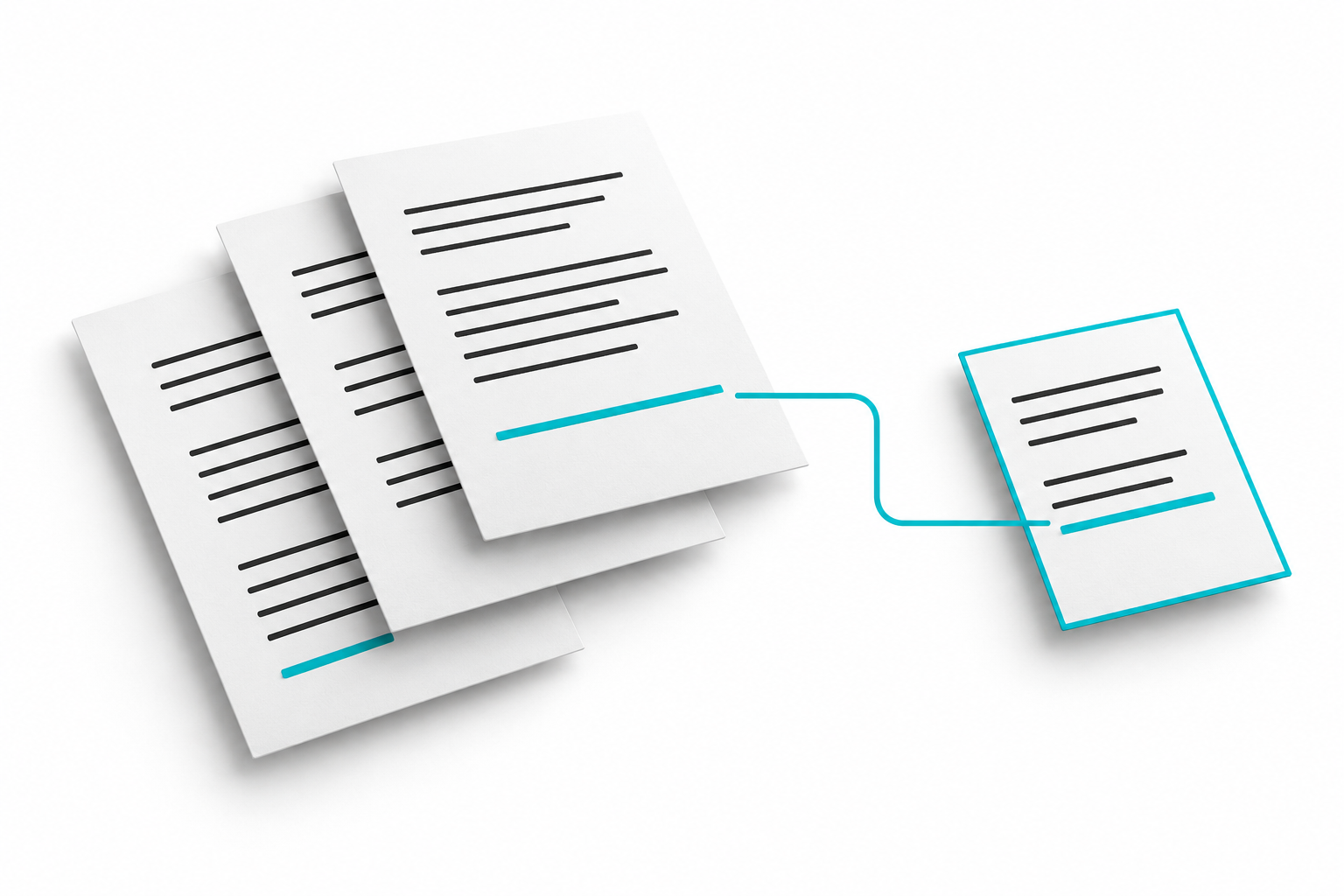
An executive receives a short AI-generated summary of a long project discussion. It is clear, organised and easy to read. It says the team supports moving ahead.
In the original discussion, however, support was conditional. Operations wanted a fallback in place. The data owner questioned whether the sample represented normal demand. One unresolved dependency could change the launch date.
This is a hypothetical example, but it exposes a useful review question: does the summary preserve the information that could change the decision?
Checking individual facts is necessary. It is also worth checking what disappeared. A summary can contain statements supported by the source while leaving out the qualification that makes those statements useful.
Start with the decision the summary will support
“Summarise this meeting” tells an assistant to shorten material. It says little about what a reader must be able to decide afterwards.
Before requesting a summary, specify its purpose. Is the reader deciding whether to release a service, approve a proposal or investigate a problem? Which conditions could change that choice? What source material is available, and what falls outside it?
My AI for Business workshop material emphasises a clear task, relevant context, reference material and a defined output. Applied to summarisation, that means describing the decision as well as the desired length. The following approach is a practical extension of those principles, rather than a claim that one prompt can make a summary reliable.
For a decision brief, ask for the recommendation, its supporting evidence, the conditions attached to it and the unresolved points. Keep those elements visible even when the main narrative is short.
Preserve four things that compression can hide
A useful review focuses on the details most likely to affect interpretation:
- Conditions. “Proceed after the access review” must not become “proceed.” Preserve prerequisites and the person responsible for confirming them.
- Disagreement. If informed participants reached different conclusions, retain the substance of their reasons. Do not translate an unresolved objection into general support.
- Scope. Evidence from one team, period or operating condition should retain that boundary. A result from a controlled demonstration does not automatically describe normal operations.
- Uncertainty. Keep estimates, assumptions and missing information distinct from verified observations. A date proposed during discussion is not a confirmed commitment.
Preserving disagreement does not mean giving every comment equal weight. A concern that was investigated and resolved should be identified as resolved, with its basis. Repeating it as an open objection would distort the record in the other direction.
Make the source easy to reopen
For each decision-critical point, include a usable source reference: a section, paragraph, document version or meeting timestamp, depending on the material. A generic link to a long file leaves the reviewer doing the search again.
Check the reference itself. Does it support the sentence beside it? Does nearby text add a condition? Is the cited version the one the team actually reviewed? A citation is a route to evidence, not a substitute for reading it.
Keep access boundaries intact. A summary intended for a wider audience should not reveal restricted details simply because the assistant could read them. Where a relevant condition depends on confidential information, use an approved description and route authorised reviewers to the controlled source. Avoid copying sensitive source passages into a new document without a legitimate need.
Review in both directions
Most reviews move from the summary to the source: “Is this statement supported?” Add the reverse direction: “Which important source points are missing from the summary?”
Consider the earlier hypothetical launch discussion. A reviewer could trace “the team supports proceeding” to several positive comments and still miss the unresolved fallback requirement. Starting with the source’s decision conditions would make that omission easier to notice.
Use two short passes:
- Support check: verify the summary’s claims, owners, dates and recommendations against the source. Remove invented certainty or commitments.
- Omission check: identify the source’s material conditions, objections, limitations and open questions. Confirm that each remains visible, or record why it does not affect the decision.
For consequential decisions, have someone familiar with the work perform the omission check. Asking the same assistant to criticise its summary may help find problems, but it should not be treated as independent verification.
Give unresolved points a place in the brief
A concise brief can use a small, repeatable structure:
- Decision required.
- What the available evidence supports.
- Conditions that must be satisfied.
- Material disagreement and whether it remains unresolved.
- Missing evidence, with the next responsible person or step.
- Source references and the boundary of the material reviewed.
The last item matters. If the assistant received only part of a discussion, the brief should say so. “No objections found in the supplied notes” is narrower than “there were no objections.” Similarly, a missing response does not establish agreement.
Where the source cannot establish a conclusion, preserve the gap rather than filling it with a plausible narrative. My article on AI answer boundaries explores how to make that stopping point useful. If a decision is later challenged, the review and challenge process should be able to recover the reasoning behind it.
Measure usefulness beyond the shorter reading time
When testing a summarisation workflow, review whether people can recover the original decision conditions, distinguish unresolved disagreement from settled issues and locate the supporting material. Include examples where a single qualification changes the appropriate next step.
This is consistent with the NIST AI RMF 1.0 Core, whose MEASURE 2.9 addresses interpreting AI outputs in context, and whose GOVERN 4.1 promotes critical thinking. NIST does not prescribe the brief structure or two-pass review above.
A shorter document is useful when it reduces reading effort without quietly narrowing the decision-maker’s view. Before approving the next AI-assisted brief, ask: “What would I need to know before disagreeing with this recommendation?” Then check that the summary has not removed the answer.
If your team uses AI to prepare decision briefs, schedule a consultation to examine the source boundaries, review responsibilities and practical checks around that workflow.